
About the H2HC Prizes for Innovation
The Hunger to Health Collaboratory (H2HC) is an innovative national model that convenes cross-sector thought leaders to explore innovative, systemic solutions to food and nutrition challenges with a focus on equity and the social drivers of health, including at an annual Fall Summit. Since 2018, H2HC has awarded $2.2M in grants and prizes to support change-making work around the U.S.
The H2HC Prizes for Innovation identify and highlight innovative food and nutrition work that offers promising, upstream models and replicable, scalable solutions that significantly advance health equity in communities throughout the U.S.
Past Prize Winners

2025 Prize Winners
The 2025 winners for the Prizes for Innovation are: Community Food Advocates and The Policy Project (Food and Nutrition Policy Work Advancing Health Equity for Youth); Boulder County Farmers Markets and Grades of Green (Nutrition Education and School Food); and Central Council of Tlingit & Haida Indian Tribes of Alaska and Dream of Wild Health (Indigenous Food Justice for Youth).
Food and Nutrition Policy Work Advancing Health Equity for Youth Prize Winners
- Community Food Advocates (New York, NY): Nearly one in five NYC children – disproportionately Black and Latinx – experience hunger, which has lifelong impacts on their physical health, mental wellness, and academic achievement. Community Food Advocates works to ensure that all New Yorkers have access to healthy, affordable, culturally affirming foods in a sustainable, equity-centered food system, advanced by high-impact public policy. The organization’s goal is to build the most innovative school meals program in New York City by developing and scaling highly effective nutrition collaboratives in every school.
- The Policy Project (Salt Lake City, Utah): In Utah, one in six students experience food insecurity, preventing thousands of children from thriving academically, emotionally, and developmentally, and uneven school capacity limits participation in existing free meal programs, keeping available food resources out of reach for many eligible students who need them. The Policy Project is leading a bold and collaborative approach to build a more equitable future using a strategic framework called the Policy Pathway, which aims to create systems that work better for everyone and ensure that policies aren’t just passed, but that they’re embraced, implemented, and sustained.

Nutrition Education and School Food Prize Winners:
- Boulder County Farmers Markets (Boulder, CO): Boulder County Farmers Markets is dedicated to strengthening the community’s regional food system by supporting, promoting, and expanding access to locally grown and made products for all members of the community. The organization believes that everyone deserves access to fresh, local, nutrient-dense food, and works in partnership with farmers, ranchers, and food businesses to make that possible. The organization is currently working to implement Farm to Early Care and Education (ECE) at 82 childcare programs across Boulder County.
- Grades of Green (El Segundo, CA): Grades of Green is an environmental nonprofit providing free educational lessons, projects, and resources to empower K-12 students to take action and lead environmental change in their communities. Since 2009, Grades of Green has activated over 800,000 students across 600+ schools, helping them drive meaningful change through student-led programs that blend academic learning with civic action. In partnership with Vista Charter Middle School, Grades of Green plans to co-create a holistic, student-powered program that transforms an underutilized campus into a vibrant hub for health, sustainability, and community connection.
Indigenous Food Justice for Youth Prize Winners:
- Central Council of Tlingit & Haida Indian Tribes of Alaska (Juneau, AK): The Central Council of Tlingit & Haida Indian Tribes of Alaska is committed to promoting self-sufficiency and preserving traditions to all Tribal Citizens. To shrink the knowledge gap between elders and youth, the organization’s Traditional Food Security program partners with the Early Education department to replace less healthy, non-traditional items on the Head Start menus with Indigenous foods from the region. This has allowed more than 230 students ages 3-5 years-old to connect with the same foods that have provided for its people since time immemorial, lessen consumption of processed foods, and reduce reliance on the food systems of the continental US.
- Dream of Wild Health (Minneapolis, MN): Dream of Wild Health is one of the longest continually operating Native American organizations in Minneapolis, which is home to one of the largest concentrations of urban Native Americans in the United States. Its mission is to restore health and well-being in the Native community by recovering knowledge of and access to healthy indigenous foods, medicines, and lifeways. Its programs impact over 12,000 people each year, creating opportunities for youth employment, entrepreneurship and leadership; increasing access to Indigenous foods through farm production, sales and distribution; and community organizing and outreach around reclaiming cultural traditions, healthy indigenous food, cooking skills, and policy and systems change.
2024 Prize Winners
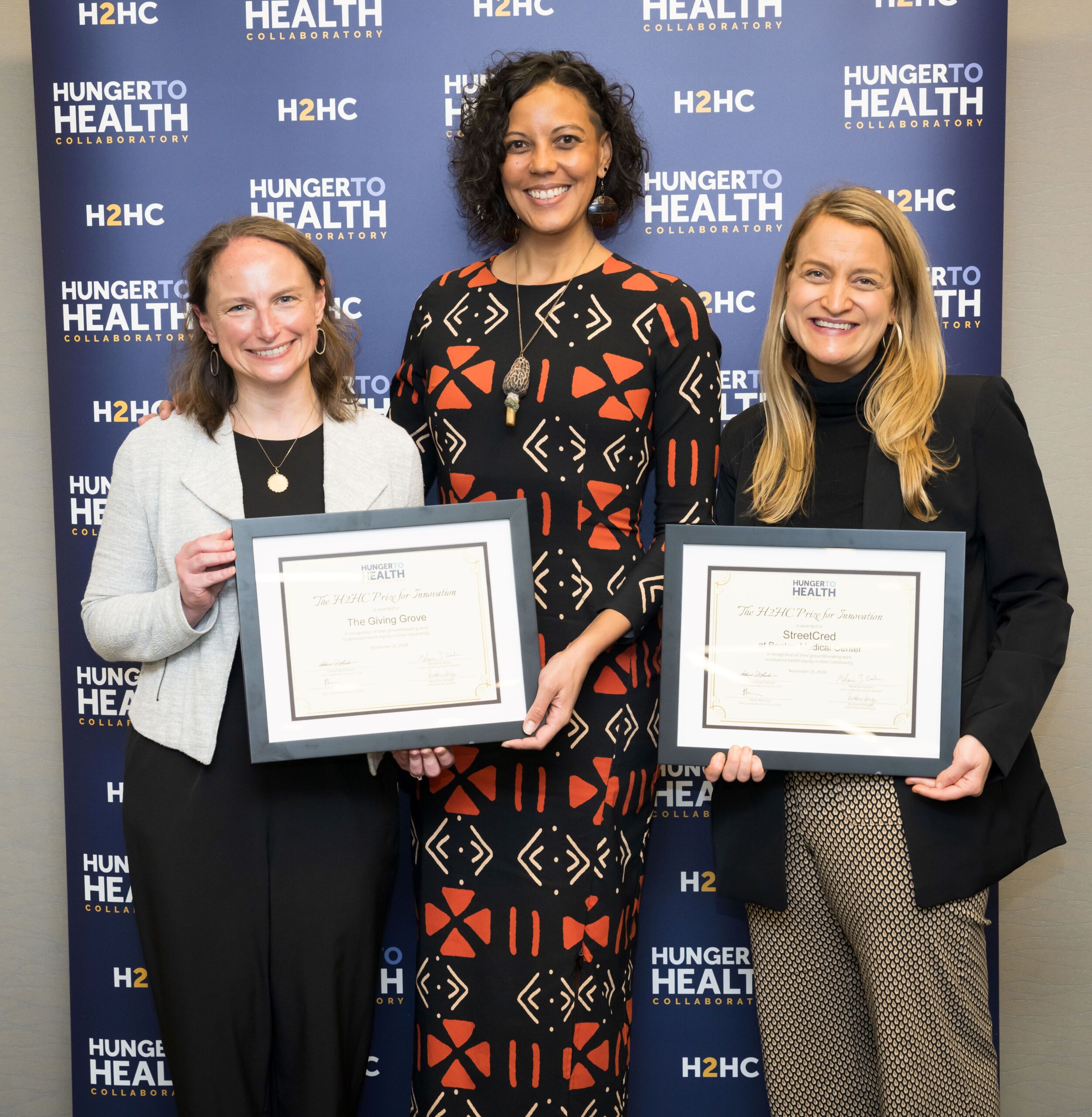
The 2024 Prizes for Innovation were awarded to StreetCred at Boston Medical Center and The Giving Grove.
- StreetCred, based at Boston Medical Center (BMC), helps families build nutrition security through enhanced economic stability. StreetCred provides families with financial coaching, helps them access asset-building services like SNAP and WIC, and provides free assistance with tax preparation and paid family leave applications. StreetCred founded the national Health by Wealth Collective to support health systems to integrate similar services into medical settings. The Collective has grown to 36 member organizations across 13 states and since 2016 has returned more than $16.8 million to 7,700 families.
- The Giving Grove is a national network that supports community-based partners in planting and caring for fruit trees, nut trees, and berry brambles. Their work improves urban environments, increases the tree canopy, and provides sustainable sources of free, organically grown food in neighborhoods facing food insecurity. Their network of 740orchards is growing more than 6.6 million servings of free, fresh food annually and re-invigorating urban green spaces. The Giving Grove is developing a 20-city network that will impact 15% of all food-insecure Americans and create sustainable, local food systems.
2023 Prize Winners
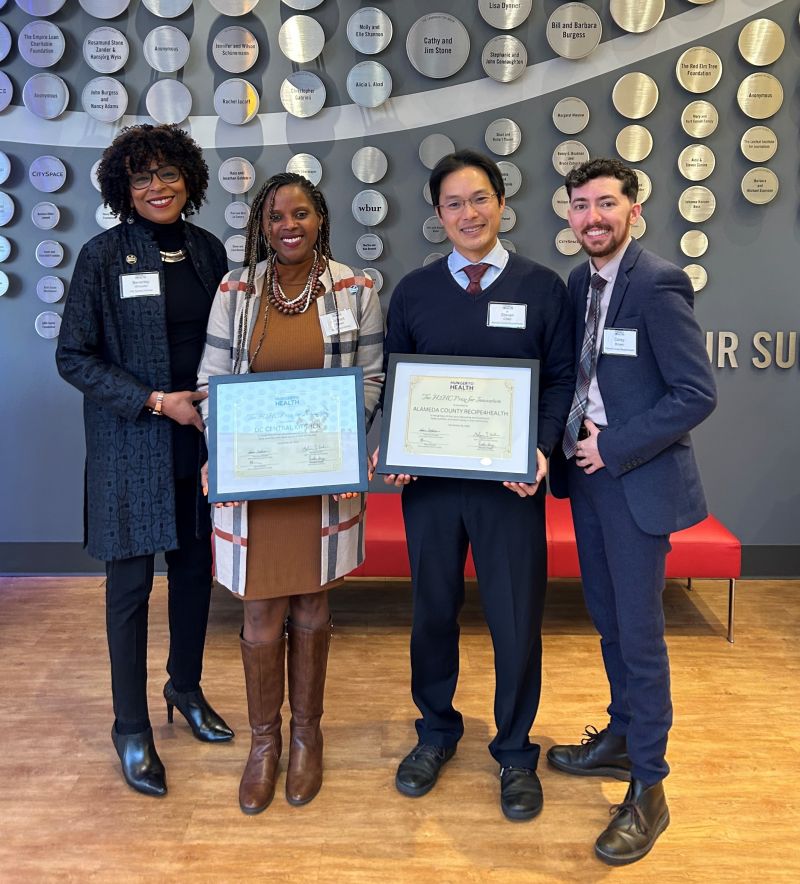
The Inaugural H2HC Prizes for Innovation were awarded to Alameda County Recipe4Health and DC Central Kitchen. Learn more about the winning organizations below and watch the prize ceremony here.
- Alameda County Recipe4Health is a nationally recognized, award-winning model that integrates food-based interventions into healthcare settings (Food as Medicine) to treat, prevent. and reverse chronic conditions; to address food and nutrition insecurity and other social determinants of health; and to improve health and racial equity. By sourcing the food from BIPOC organic and regenerative farmers, Recipe4Health leverages healthcare and agriculture to generate multipliers for human health, economic health, climate health, and equity.
- DC Central Kitchen is an iconic nonprofit and social enterprise that combats hunger and poverty through job training and job creation. The organization provides hands-on culinary job training for individuals facing high barriers to employment while creating living wage jobs and bringing nutritious, dignified food where it is needed most – including public schools, neighborhood corner stores, and food-insecure communities throughout the city.